President Message
Shaping “Tomorrow’s Surgeon”:
The Vision for 2026
A very warm welcome to the home of Sri Lankan surgeons: the Noel and Nora Bartholomeusz Foundation. This year, we celebrate 22 years at Independence Avenue. We are deeply grateful for the benevolence of Noel and Nora Bartholomeusz, and it is a personal privilege that we have brought Dr. Bartholomeusz’s RCS England Fellowship Robe home to the College as a symbol of our heritage.
I thank our Immediate Past President, Dr. Duminda Ariyarathne, and Honorary Secretary, Dr. Malik De Soyza, for their exceptional work. I also acknowledge our Past Presidents and members who have tirelessly contributed to national policy, training, and innovation, delivering cost-effective surgical care to every corner of our island, 24/7.
Beyond our shores, we have strong regional collaborations through the South Asian Surgical Care Society and maintain vital ties with the Royal Colleges of the UK, Australia, and Malaysia. These partnerships solidify our position as the undisputed apex body for surgeons in Sri Lanka.
I stand upon a foundation built by giants. As we move forward, we must invest deeply in our future. My vision is to shape “Tomorrow’s Surgeon” based on three core pillars: Academia, Integrity, and Accountability.
Pillar 1: Academia – Excellence & Research
The College plays a crucial role in enhancing surgical skills through immersive training, including the internationally recognized National Trauma Management Course (NTMC) and basic laparoscopy courses at our training centre.
Advancing Simulation: We will actively promote simulation using human cadaver models. We currently conduct cadaver-based training across multiple specialties, including a new venture in cadaveric laparoscopic training led by Prof. Srinath Chandrasekara. The College will champion simulation to ensure patient safety and technical mastery.
Catalysing Research: Research has been a challenge. To address this, I am pleased to announce the launch of a Collaborative Research Programme in partnership with the industry. This initiative will provide research support to generate essential knowledge impacting patient care and national policy.
Pillar 2: Surgical Integrity
Surgical integrity means developing a “surgical conscience”: the wisdom to know when to operate, and the courage to know when not to. To strengthen this, we will incorporate non-technical “power skills” into our core curriculum in 2026 through the Surgical Education & Training Sessions (SETS). Furthermore, we will commence monthly Cross-Border Case Discussions with American surgical groups to promote ethical and professional critique of our practice.
Pillar 3: Accountability – Service & Sustainability
The College is accountable for providing cost-effective surgical services. We work closely with the Ministry of Health to evaluate surgical procurements. We must balance progress with economic reality. For example, twenty years ago, the foresight to invest in laser technology for urinary stones enabled day-case surgery and returned that investment to the country exponentially. We must continue to make such strategic, patient-centred decisions.
We must also be accountable for the investment made in our surgeons. The migration of trainees is a significant drain. However, as WHO statistics confirm, Sri Lankan healthcare remains among the most cost-effective in the world. To encourage our surgeons to stay and serve, we will implement a mentoring programme for newly appointed surgeons. A team of senior surgeons will guide these “bright young sparks” as they transition to serving in our provincial hospitals. As I believe, if we cultivate our garden, the birds will flock to it.
A Heartfelt Thank You
I thank the Council and membership for entrusting me with this responsibility.
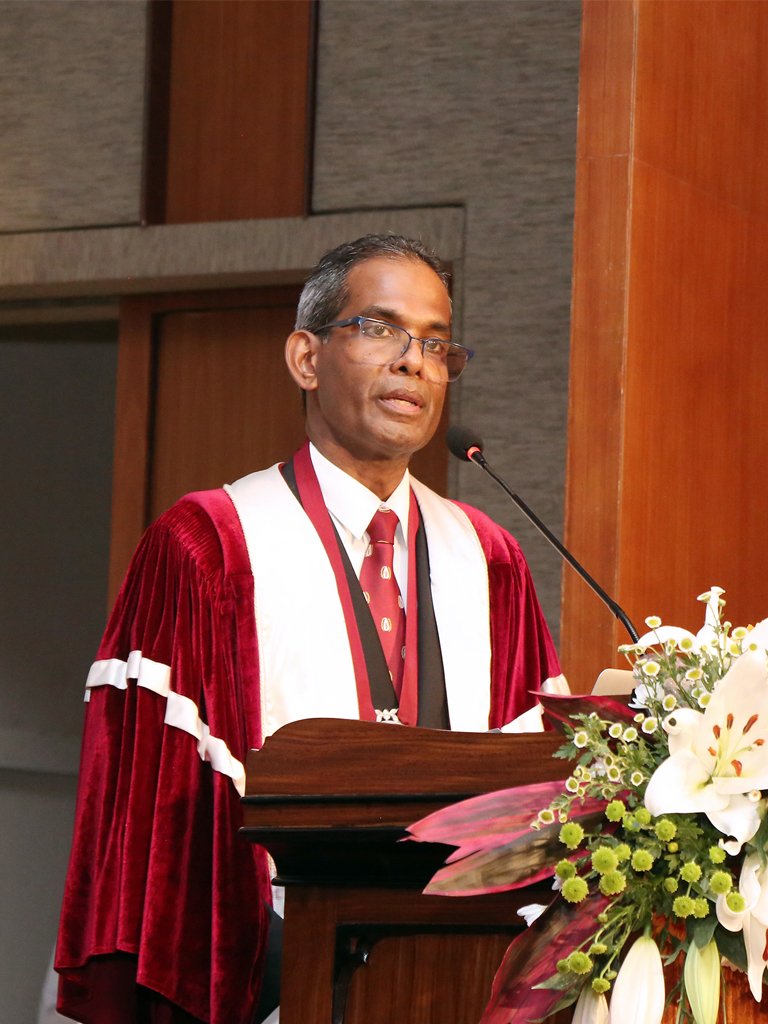
— Prof Ajith Malalasekara, President, College of Surgeons of Sri Lanka